Trailing Drawdown: How It Actually Changes the Way You Trade
Static, end-of-day and real-time trailing drawdown with worked numbers — and the operating rules that follow once you know which one you trade under.
Most explanations of trailing drawdown stop at the definition. You read them, you nod, and then you fail an account anyway — because knowing what trailing drawdown is doesn’t tell you how to trade differently under it.
This is the version that tells you what to actually do. The mechanics first, because they matter, and then the specific operating rules that follow from them.
The Three Kinds
Static drawdown. A fixed floor set at the start that never moves. On a $50,000 account with a $2,500 static limit, your floor is $47,500 forever. Make $10,000 and it’s still $47,500 — you now have $12,500 of room. This is the friendliest structure and increasingly rare in futures prop.
End-of-day trailing. The floor moves up based on your closing balance each day. Intraday swings don’t count. If you’re up $800 at noon and close the day flat, the floor doesn’t move. Substantially more forgiving than the alternative, and it lets you hold positions through normal fluctuation without being punished.
Real-time (intraday) trailing. The floor follows your highest equity at any moment, including unrealized profit on open positions. This is the strict one, it’s common in futures prop, and it’s the one that ends accounts.
Most firms also stop the trailing at some point — typically once the floor reaches your original starting balance, sometimes slightly above. Everything about how you should trade changes at that threshold, which is why it deserves more attention than it usually gets.
Find out which one you have before you place another trade. It’s in your firm’s rules document, and traders routinely assume end-of-day when they’re actually on real-time.
The Number That Costs People Accounts
Here’s real-time trailing with actual numbers, because the abstract version doesn’t land.
Account: $50,000. Trailing drawdown: $2,500. Floor starts at $47,500.
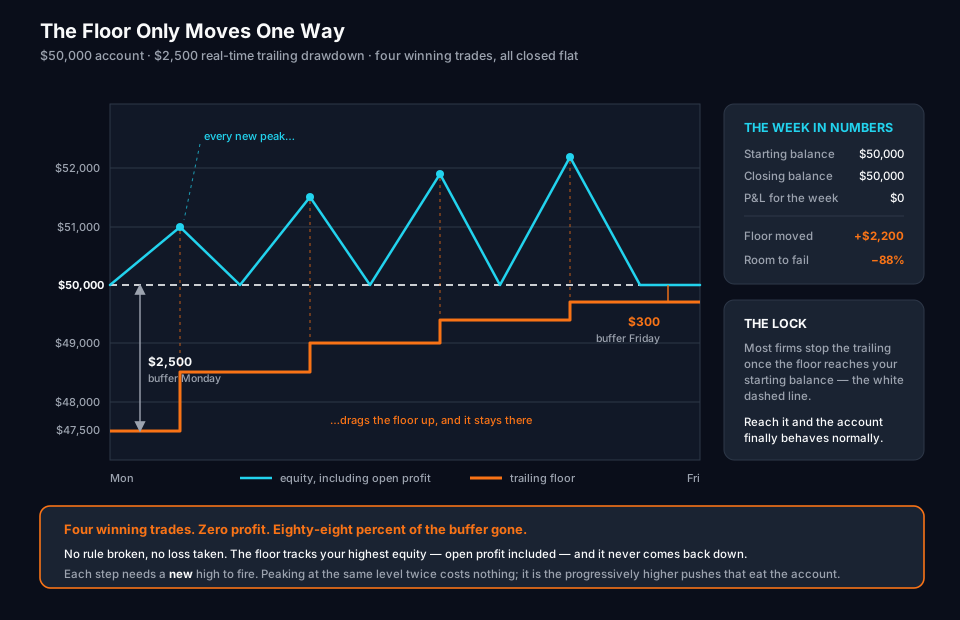
You enter a trade. It moves your way and your open position shows +$1,000. Your equity peaks at $51,000, so your floor immediately moves to $48,500.
The trade reverses. You close it exactly at breakeven. Balance: $50,000.
Your floor does not come back down. It stays at $48,500.
You just lost $1,000 of buffer on a trade that made you nothing. You didn’t lose money. You didn’t break a rule. You didn’t do anything a trading book would call wrong. Your room to fail shrank by 40% and nothing in your P&L shows it.
One detail matters here, because it’s the difference between a scary story and the actual mechanism: the floor only moves on a new equity high. Peaking at $51,000 a second time costs you nothing — the high-water mark is already there. It’s the pushes that go progressively further that do the damage.
So do that four times across a week, each one reaching a little higher than the last — $51,000, then $51,500, then $51,900, then $52,200 — and close flat every time. Your balance is exactly where it started on Monday. Your floor has climbed to $49,700, and your room to fail has gone from $2,500 to $300.
This is how funded accounts die. Not from a big loss. From giving back open profit repeatedly while the balance sits still.
What Follows: Open Profit Is a Liability
Once you internalize the math above, several standard pieces of trading advice invert.
“Let your winners run” is dangerous before the lock. Under real-time trailing, every tick of unrealized profit you don’t capture is buffer you’ve spent. Letting a winner run and giving half of it back is, in drawdown terms, a losing trade. The wider you let a position breathe, the more buffer it costs you when it retraces.
Trailing stops are expensive. A trailing stop by definition gives back a portion of the move. Under real-time trailing drawdown you pay for that giveback twice — once in the P&L and once in the floor that already moved up and stayed there.
Banking winners beats optimizing them. Taking a defined target and getting flat converts unrealized profit into realized profit before the market can take it back. It’s a worse strategy in a normal account and a better one under real-time trailing, and that trade-off is the whole game before the lock.
Scaling out is better than scaling up. Taking partials locks buffer in stages. Adding to a winner increases the unrealized peak, which raises your floor faster than it raises your balance.
None of this is how you’d trade your own money. That’s the point — you’re not trading your own money, you’re trading under a specific set of mechanical constraints, and the constraints should shape the tactics.
The Lock Is the Only Milestone That Matters
Most firms stop trailing once the floor reaches your starting balance. Getting there is a bigger deal than passing the evaluation, and almost nobody treats it that way.
Before the lock, you’re playing a game where profit is fragile and every retracement is permanent. After the lock, your floor is fixed at your starting balance, every dollar above it is genuinely yours to risk, and the account finally behaves like a normal one.
The practical consequence: the period between getting funded and hitting the lock is the most dangerous stretch of the entire process, and it’s the one people are least careful in. They just passed. They feel good. They size up. The buffer is at its thinnest precisely when confidence is at its highest.
Treat everything before the lock as a continuation of the evaluation, not a reward for finishing it.
Operating Rules
Concrete, and they follow directly from the math.
Know your real number, not the advertised one. If your floor is $48,500 and your balance is $50,000, your risk budget is $1,500 — not the $2,500 printed in the rules. Check the actual gap before every session, not the marketing figure.
Set your own daily limit against the buffer. A common approach is capping daily loss at somewhere around a quarter of current buffer. At $1,500 of room, that’s roughly $375, and it means four consecutive bad days can’t end you. Your firm’s daily loss limit is designed to protect the firm, not you — yours should be tighter.
Trade the smallest instrument available before the lock. Micros over minis, every time. The buffer is the scarce resource, and micros let you take the same setups while spending a fifth of it. Size up after the lock, not before.
Take profit at defined targets pre-lock. This is the single highest-leverage change. Fixed targets, get flat, let the buffer accumulate. There’s time for discretionary exits after the floor stops moving.
Watch the drawdown number, not the P&L. Put your current buffer somewhere you see it before every entry. Most platforms will show trailing drawdown as a field. If yours doesn’t, calculate it manually each morning. The P&L tells you how you did; the buffer tells you how much longer you get to keep playing.
Flat before the close, especially pre-lock. An overnight position under real-time trailing can move your floor while you sleep.
How This Plays Out Across Firms
Firms differ in ways that matter more than their profit splits, and the differences are easy to miss when you’re comparison shopping.
The variables worth checking before you buy an evaluation:
- Which trailing type, and whether it differs between the evaluation and the funded account. Some firms run end-of-day on the eval and real-time once funded, which is a nasty surprise.
- Where the trailing stops — starting balance, starting balance plus a fixed amount, or never.
- Whether unrealized profit counts. This is the whole ballgame on a real-time account.
- Whether the floor resets after a payout. Some firms recalculate, some don’t.
These change frequently. Read your own firm’s current rules document rather than trusting any comparison table, including the ones on sites like this.
Bottom Line
Find out which type you’re on. If it’s real-time, accept that unrealized profit is borrowed and behave accordingly — smaller size, defined targets, bank the winners, flat at the close.
Then treat the lock as the actual finish line. Passing the evaluation gets you a seat. Reaching the point where your floor stops moving is what gets you an account you can actually trade.
The traders who fail funded accounts mostly aren’t failing at analysis. They’re failing at buffer arithmetic they never ran.
Common Questions
What is trailing drawdown in a prop firm account?
Trailing drawdown is a loss limit whose floor rises as your account grows. Instead of a fixed minimum balance, the floor follows your account's high-water mark upward, so a run of profit permanently raises the level at which you fail.
What is the difference between static and trailing drawdown?
A static drawdown floor never moves — it is set at the start and stays there. A trailing floor follows your equity high upward, meaning the amount of room you have below your current balance stays roughly constant instead of growing as you profit.
What is the difference between end-of-day and intraday trailing drawdown?
End-of-day trailing updates the floor once per day based on your closing balance, so intraday swings do not count against you. Intraday or real-time trailing updates the floor continuously against your highest equity including unrealized profit, which is far stricter.
Does unrealized profit count toward trailing drawdown?
Under real-time trailing drawdown, yes. Your floor rises the moment your open position shows profit, and it does not come back down when that profit evaporates. This means you can lose buffer on a trade you eventually close at breakeven.
Does trailing drawdown ever stop trailing?
At most firms, yes. The floor typically stops rising once it reaches a defined threshold, often the account's original starting balance or slightly above it. Reaching that point is the single most important milestone in a funded account.
Is trailing drawdown the same as a daily loss limit?
No, and confusing them ends accounts. The daily loss limit resets each session. The trailing floor is cumulative and permanent. You can be well inside your daily limit and still be one bad trade from your trailing floor.
Why do prop firms use trailing drawdown at all?
It caps their downside on every account continuously rather than only at the start. From their side it is straightforward risk management. It is not a trick, but it is designed with their interests in mind rather than yours.
What happens when you hit the trailing drawdown floor?
The account closes. Most firms offer no warning and no grace period, and on real-time trailing it can happen on an open position without you having closed anything.