How to Stay Funded After You Pass a Prop Firm Challenge
Passing and staying funded reward opposite behaviour. Why funded accounts die in the first two weeks, and the rules that keep one alive long enough to pay.
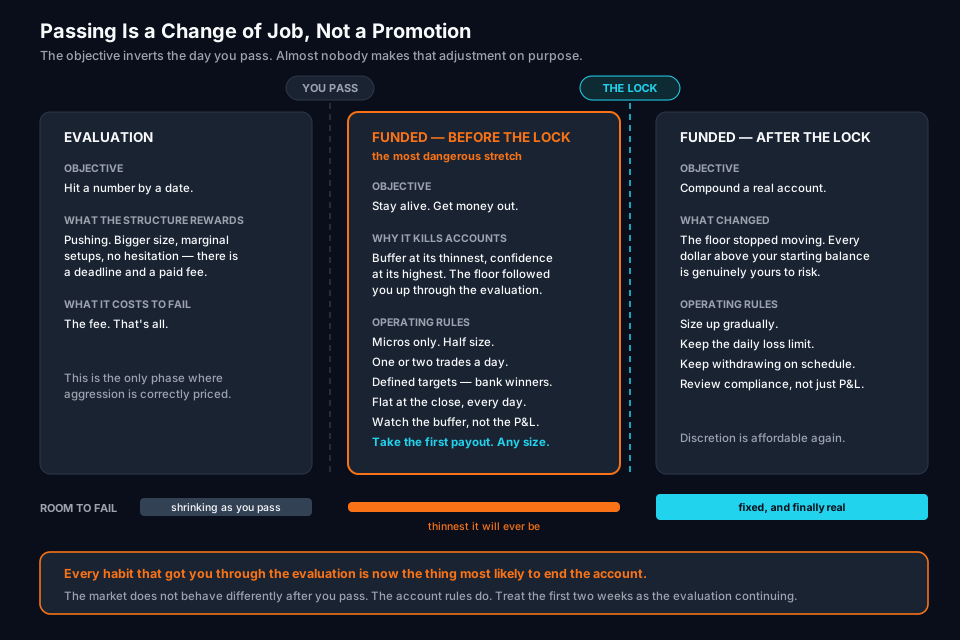
There’s a particular kind of trader who passes evaluations. They can hit a profit target under a deadline. They’ve proven it more than once. And they’ve never taken a payout.
This is more common than the prop firm industry likes to discuss, and it isn’t an analysis problem. It’s a structural one: the evaluation and the funded account reward opposite behaviors, and nobody tells you the rules changed.
The Switch Nobody Warns You About
An evaluation hands you a profit target and, usually, a time limit. That structure has a shape, and the shape rewards pushing. Take the bigger size. Take the marginal setup. You need a number by a date, and hesitation costs you the fee you already paid.
Then you pass, and overnight the objective inverts. There is no target anymore. There is no deadline. The only things that matter now are staying alive and getting money out.
Every habit that got you through the evaluation is now the thing most likely to end the account.
Almost nobody makes that adjustment consciously. You finish the challenge on a Friday feeling sharp, the funded account appears on Monday, and you trade it exactly the way you traded the one before it. The market doesn’t behave differently. The account rules do.
Why the First Two Weeks Kill Accounts
The most dangerous stretch is immediately after passing, and it’s dangerous for a reason that compounds.
Your buffer is at its thinnest. On a trailing drawdown account, the floor followed you up through the evaluation. You start funded with a small gap between your balance and your failure point — often smaller than the number advertised in the rules.
Your confidence is at its highest. You just did the hard thing. You proved it works.
Thin buffer plus high confidence is the worst combination available. It produces sizing decisions that would be reasonable on a seasoned account and are fatal on a new one.
The fix is unglamorous: treat the first two weeks as an extension of the evaluation. Same discipline, same size or smaller, no celebration trades. You haven’t finished. You’ve moved to the part that actually pays.
Get Money Out Early
The single highest-value habit on a funded account is withdrawing, and it’s the one traders resist most.
The logic against it feels sensible. The balance is small. Withdrawing shrinks the account and slows compounding. Better to build it up and take a meaningful payout later.
The logic is wrong, for one reason: an account balance is money you can still lose. A withdrawal is money you cannot.
Traders who wait for a bigger number frequently never withdraw at all. The account dies at some point before the target — it always does, eventually, on a long enough timeline — and every dollar that was still sitting in it goes with it. The trader has now proven they can trade profitably and has been paid nothing for it, which is a strange and demoralizing place to end up.
Take the first withdrawal the moment you’re eligible, even if it’s small. It converts a hypothetical into a real one. It also does something to your relationship with the account that’s hard to describe until you’ve done it — the thing stops being a video game score and starts being a job that pays.
Then keep withdrawing on a schedule rather than a feeling.
Size Down After Passing
This is the most counterintuitive rule here and the one that separates accounts that last from accounts that don’t.
You would expect to size up after passing. You’re funded now, the account is real, the profit split is real. Bigger size, bigger payout.
But the buffer math says otherwise. Before your trailing floor locks, you have less room than you did at the start of the evaluation, not more. Increasing size against a smaller buffer is exactly backwards.
Trade micros until the floor stops moving. Same setups, same process, a fifth of the risk. You give up upside during the period where upside is worth the least and survival is worth the most.
After the lock — when your floor is fixed and every dollar above it is genuinely yours to risk — size up. Not before.
The Green Day Trap
Here is the specific sequence that ends more funded accounts than any single bad trade.
You have a good day. Well above your average. The setups were clean, you executed properly, and you finish up meaningfully.
The next session you’re sharper than usual, and you’re carrying a feeling that the market is readable right now. So you take a slightly bigger position. Then, when an ordinary loss shows up, you take another trade to get it back — because yesterday proved you can.
By the close you’ve given back the green day and some of the buffer. And the buffer doesn’t rebuild the way the balance does.
A green day is a risk event, not a reward. The most useful rule available is a hard stop after a strong day — you’re done, log it, walk away. Banking the day is the trade.
The mirror image matters too: a hard daily loss limit, set well below your firm’s, that ends the session when it’s hit. Not a target you aim to avoid. A switch that turns the platform off.
Track Compliance Separately From P&L
Most traders review a funded account by looking at the equity curve. The equity curve is a lagging indicator of a problem that showed up earlier somewhere else.
Track two things per trade, separately from whether it made money:
Did I follow my plan? Binary. Yes or no. Not “mostly.”
Did I stay inside my own limits? Size, daily loss, number of trades.
Then look at the ratio weekly. A rising rate of plan-broken trades predicts account failure well before the balance reflects it — usually by one to two weeks. That’s enough time to correct, if you’re measuring it.
The seductive case is the plan-broken trade that made money. It feels like evidence that the rule was too tight. It’s the most expensive kind of feedback there is, because it trains the exact behavior that will end the account later, on a trade that doesn’t cooperate.
Grade execution, not outcome. A disciplined loss is a good trade. A reckless win is a bad one.
A Workable First Month
Nothing here is complicated. It’s just harder than it looks, because every rule is a rule against your own momentum.
Week one and two. Micros only. Half your normal size. One or two trades a day, maximum. No trading after a loss that hits your daily limit. Treat it as the evaluation continuing.
Until the trailing floor locks. Defined targets, bank winners, get flat at the close. Watch the buffer number before every entry, not the P&L. Assume nothing is yours yet.
First eligible payout. Take it. Whatever the size.
After the lock. Now you have a real account with real room. Size up gradually. Keep the daily loss limit. Keep withdrawing on schedule.
Every week. Review plan-compliance rate, not just P&L. Pick one thing to change. Measure it the following week.
Bottom Line
Passing proves you can hit a number under pressure. Staying funded proves something else entirely, and the two require nearly opposite behavior.
Treat the first weeks as the evaluation continuing. Trade smaller than feels right until your floor stops moving. Take money out early and on a schedule rather than waiting for a number that feels worthy. And measure whether you followed your plan, separately from whether the trade worked.
A trader who passes evaluations and never withdraws hasn’t failed at trading. They’ve failed at the part after trading — and that part is a set of rules, not a skill.
Common Questions
Why do so many traders lose funded accounts after passing?
Because evaluations and funded accounts reward opposite behaviors. An evaluation has a profit target and a deadline, which rewards aggression. A funded account rewards survival and withdrawal. Traders carry their evaluation habits into the funded account and the same aggression that passed the challenge destroys it.
How long do most funded accounts last?
The highest-risk period is the first two weeks after passing. That is when the drawdown buffer is thinnest and confidence is highest, which is the worst possible combination.
Should I withdraw from a funded account as soon as I can?
Yes. Withdrawing converts an account balance you can still lose into money you cannot. Traders who wait for a larger withdrawal frequently never take one at all. Early and frequent withdrawals are risk management, not timidity.
Should I trade the same size after passing as during the evaluation?
Usually smaller. The evaluation was a sprint toward a target; the funded account is about survival. Reducing size after passing is counterintuitive and is one of the strongest predictors of an account that lasts.
What is the most common mistake on a new funded account?
Sizing up after a good day. A green day raises confidence, confidence raises size, and the larger position meets a normal losing trade against a buffer that was never rebuilt.
Is it worth passing another evaluation if I keep losing funded accounts?
Not until you have identified and fixed the reason. Another evaluation is another fee spent on the same outcome. The failure is happening after the pass, so buying more passes does not address it.
How do I stop myself sizing up after a good day?
Make it mechanical rather than a decision. A fixed maximum size that does not move, and a hard stop after a defined daily gain. Decisions made in the moment reliably favour the thing you are trying to avoid.